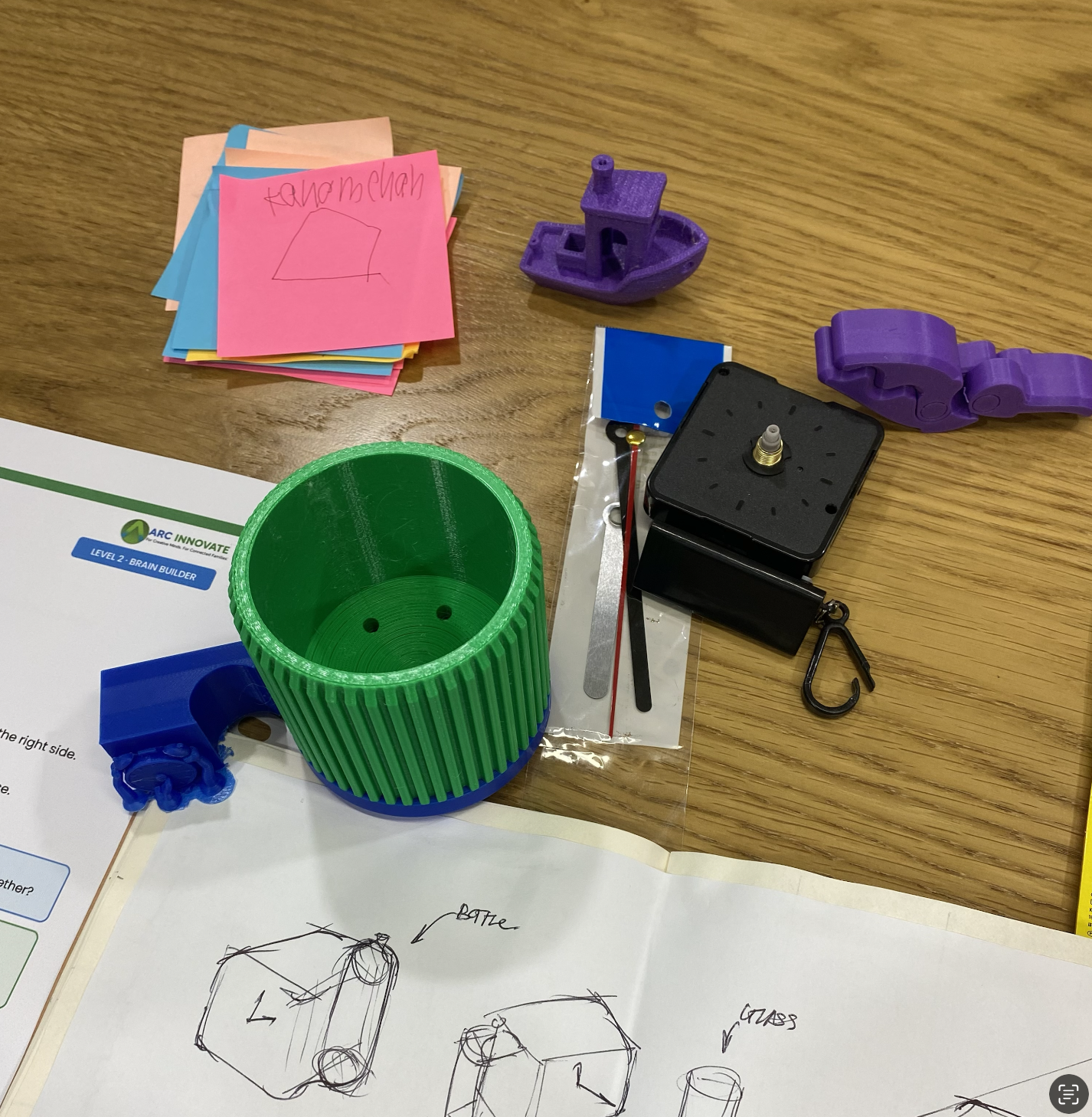
Walk into most 3D printing classes for kids and you'll see the same thing: a child sitting in front of a screen, learning to drag shapes in a software tool, waiting for their turn at the printer. They leave with a plastic object. Sometimes it's a keychain. Sometimes a phone stand. Sometimes a random shape they thought looked cool.
The child learned to operate a machine. That's it.
Now walk into a design thinking class that uses 3D printing as one of its tools. You'd see something completely different — and understanding why is the most important thing a Bangkok parent can know before enrolling their child in any maker program.
The Question Isn't Which Comes First. It's Which One Drives.
Here's the honest answer: 3D printing is part of design thinking. Design thinking is never part of 3D printing.
3D printing is a tool — one of the most powerful prototyping tools ever invented for children, but still just a tool. Design thinking is a process — a complete framework for how human beings move from a problem they care about to a solution that actually works.
A hammer is part of building a house. Building a house is never part of using a hammer. The same logic applies here. When 3D printing drives the learning, children become machine operators. When design thinking drives the learning, children become problem solvers who happen to use a 3D printer.
A 3D printer without design thinking teaches a child to make things. Design thinking with a 3D printer teaches a child to solve things.
What a Tool-First Class Looks Like
In a tool-first 3D printing class, the learning arc goes roughly like this:
- Learn the software interface
- Create a pre-set shape or follow a tutorial
- Print it
- Take it home
This isn't worthless — children do develop basic spatial reasoning and a familiarity with digital tools. But there's a critical problem: the child never had to think. They were never asked why they were making what they made. They never had to understand who it was for. They never tested it, failed with it, or improved it. The printer was the point, not the process.
❌ Tool-First (3D Printing Class)
- Starts with software
- Project is chosen by teacher
- No user research
- First print = final print
- Child leaves with an object
- Skill: operate a tool
✅ Process-First (Design Thinking + 3D Printing)
- Starts with a real problem
- Project is chosen by student
- User research before building
- Multiple iterations, multiple prints
- Child leaves with a solution
- Skill: think like a designer
Where 3D Printing Belongs in the Design Thinking Process
The design thinking process has five stages. 3D printing belongs in exactly one of them — and understanding which one reveals everything about how it should be taught.
3D printing is a Prototype tool — step 4 of 5. When a class starts at step 4, it skips everything that makes the prototype meaningful. The child builds something, but they don't know why. There's no emotional investment, no real problem behind it, no user to test it on.
When a class starts at step 1 — with empathy, with a real person's problem, with genuine curiosity — the 3D printer becomes something different entirely. It becomes the moment a child's idea becomes real. That moment, earned through four weeks of thinking and research and ideation, lands completely differently than printing a pre-set shape in week one.
In our 3D Printing program, students don't touch the design software until Week 3. The first two weeks are spent finding a real problem, interviewing real people, and sketching ideas on paper. By the time they open Tinkercad, they already know exactly what they're designing and why. The print isn't the reward — it's the proof.
Why This Matters More Than Parents Realise
Here's what actually transfers out of these two different learning experiences:
A child who completes a tool-first 3D printing class knows how to use one specific piece of software. If that software changes — and it will — the skill becomes less relevant. If the child moves to a different school or context without a 3D printer, the skill doesn't travel.
A child who completes a process-first design thinking class that uses 3D printing as a tool leaves with something far more portable: a repeatable method for approaching problems they've never seen before. They know how to observe, define, ideate, build, and test. They can apply that process to a cooking challenge, a business problem, a school project, or an engineering brief — because they've internalised the thinking, not just the tool.
This is exactly the distinction the World Economic Forum's Future of Jobs research highlights: the skills most valuable in the next decade aren't domain-specific technical skills. They're complex problem-solving, critical thinking, and creativity. Design thinking directly builds all three. Operating a 3D printer builds one narrow technical skill.
The Right Question to Ask Any 3D Printing Class
Before enrolling your child, ask one question: "What happens in week one?"
If the answer is "they learn the software" or "they start their first print" — that's a tool-first class. Your child will leave knowing how to operate a machine.
If the answer is "they find a real problem they want to solve" — that's a process-first class. Your child will leave knowing how to think like a designer.
At Arc Innovate, week one is always about the problem, never the printer. Because the printer is just how the idea becomes real. And an idea only matters if it started with genuine thinking.
Our Programs That Use Design Thinking as the Foundation
3D Printing
The full design thinking process — from problem research to printed prototype. Students don't touch the printer until they've earned it with real thinking.
Explore program →Design and Innovation
Design thinking applied to physical challenges — cardboard engineering, structural problem solving, and real break-and-fix missions.
Explore program →See the Difference for Yourself
Every Arc Innovate program starts with a problem, not a tool. If you'd like to see what process-first learning looks like for your child, get in touch — we're happy to walk you through how we teach.
View All Programs 💬 Chat on Line